Modeling Liquid Flow in Presence of Gas Flow in Packed Beds
In our group, the focus is on the study of flow of non-wetting liquid through porous media under the influence of gas. In many metallurgical reactors, the liquid phase is non-wetting and flows counter-current, co-current, or cross-current to the gas phase.
A typical example is the lower region of an ironmaking blast furnace, where molten metal and slag descend over the coke matrix while interacting with the upward gas flow. Research has shown that non-wetting liquids flow as droplets and rivulets, continuously breaking and coalescing within the bed.
This behavior is fundamentally different from wetting flows, where the liquid phase forms a continuous film around the packing particles. Under lateral gas injection, the liquid holdup differs significantly from conventional counter-current or co-current flow conditions.
Our work is therefore directed toward a fundamental understanding of droplet and rivulet motion through packed beds. We model this discrete liquid behavior using a force balance approach proposed by Gupta et al. (1996, 1997).
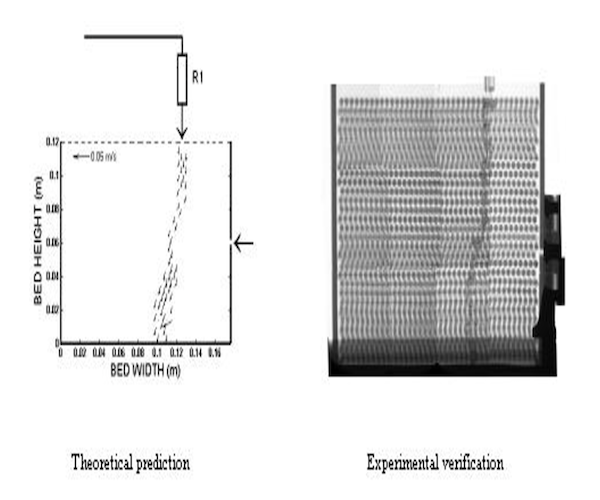
We have postulated a new theory to model non-wetting liquid flow in packed beds by treating the liquid as discrete in nature. Liquid rupture theory has recently been incorporated to extend the applicability of the model.
Gas flow is modeled by solving the Navier–Stokes equations under turbulent conditions. Experimental validation is carried out using X-ray radiography techniques for liquid flow visualization in packed beds.
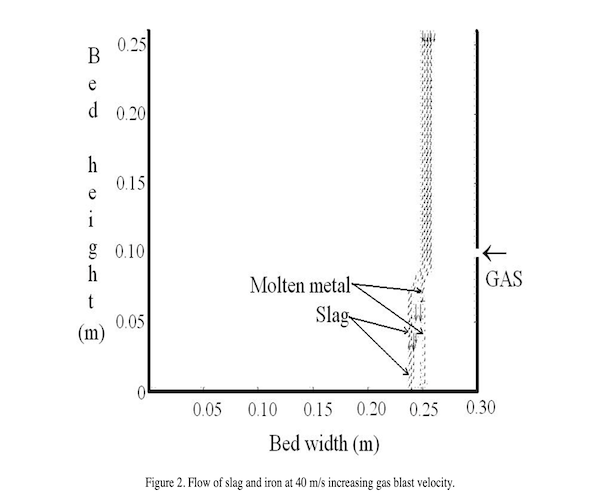
Current efforts focus on modeling slag and iron flow at high gas blast velocities (~40 m/s) and understanding gas–liquid maldistribution in random packed beds. The influence of raceway hysteresis on gas–liquid flow behavior is also being investigated.
For further details, publications, or collaboration related to this research, please contact us.